When the CISO Sits in Compliance: Governance Strength — or Security Weakness?
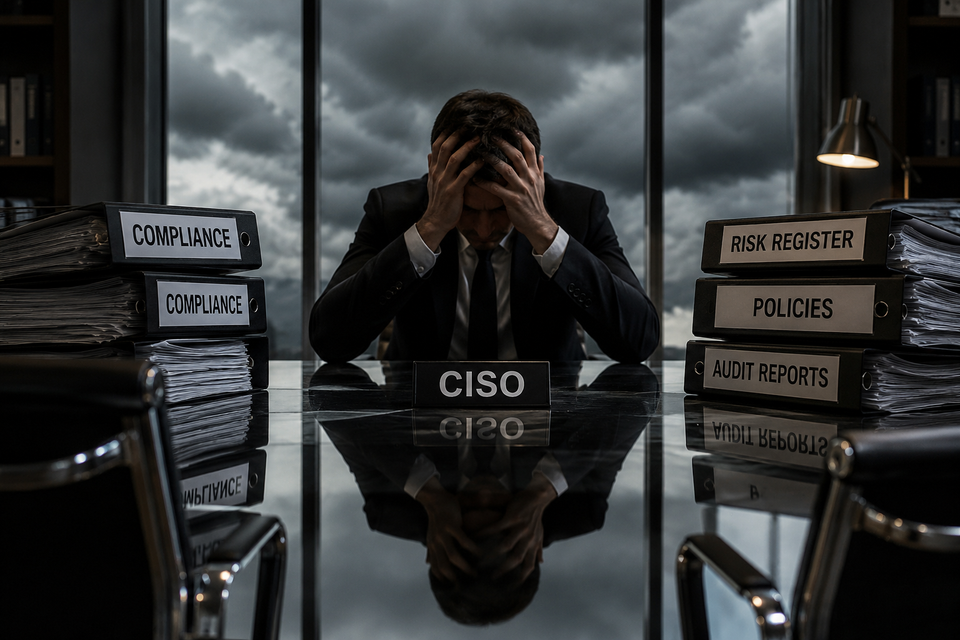
Where the CISO sits determines whether cybersecurity becomes a strategic control function — or a reporting discipline that looks mature while risks continue to accumulate underneath.
By Eckhart Mehler for CISOsCISO — a perspective on cybersecurity leadership, governance and the decisions that determine whether organizations retain control.
There is a recurring organizational debate in cybersecurity:
Where should the CISO sit?
In IT?
In Risk?
In Compliance?
In Corporate Governance?
Under the CEO?
Close to Internal Audit?
As an independent staff function?
The question is often discussed as if it were mainly about reporting lines, management preferences or organizational neatness.
It is not.
The reporting line of the CISO is one of the most consequential governance decisions an organization can make. It determines whether information security has the authority to challenge decisions before they become irreversible — or whether it becomes a function that documents risks after the fact.
This matters even more now.
Organizations are moving critical workloads to cloud platforms. They are integrating AI systems into business processes. They are outsourcing infrastructure, software development, identity management and data processing. They are becoming increasingly dependent on digital supply chains that few executives fully understand.
At the same time, cyber risk is no longer isolated from operational reality.
A ransomware incident can interrupt payroll.
A compromised identity can expose sensitive data across multiple countries.
A cloud misconfiguration can create regulatory, contractual and reputational damage at once.
An ungoverned AI deployment can turn internal knowledge into external exposure.
A failed recovery process can make the difference between disruption and organizational paralysis.
In that environment, the position of the CISO is not symbolic.
It is operational.
And that is why the idea of placing the CISO within Compliance or a Corporate Governance staff function deserves closer examination.
It can be a strong model.
But it can also become one of the most elegant ways to weaken security without appearing to do so.
Why Compliance and Corporate Governance Are Attractive Homes for the CISO
At first glance, the argument is convincing.
Cybersecurity is no longer just an IT topic. It intersects with data protection, legal obligations, operational resilience, risk management, outsourcing, procurement, business continuity, internal controls, audit requirements and board accountability.
A CISO positioned close to Compliance or Corporate Governance may gain:
- better access to executive leadership;
- more direct involvement in enterprise risk discussions;
- stronger connections to legal, privacy and internal control functions;
- greater visibility in board and supervisory board reporting;
- more influence over policies, standards and governance processes;
- clearer escalation paths outside the IT hierarchy.
That is not a minor advantage.
For years, many CISOs struggled because they were buried inside IT organizations that measured success mainly through delivery speed, service stability, cost efficiency and transformation progress.
Security was often expected to support projects, approve exceptions and reduce friction.
But when the CISO is structurally dependent on the same leadership that is accountable for delivering technology, operating platforms and meeting deadlines, independent challenge becomes difficult.
A CISO cannot effectively govern the risks of a cloud migration, a large ERP transformation or a new AI rollout when the function is expected to prioritize delivery over control.
In that sense, moving the CISO outside pure IT can be a necessary correction.
The problem begins when the move goes too far in the other direction.
Compliance Is Necessary. But Compliance Is Not Security.
Compliance asks important questions:
Are policies in place?
Are responsibilities defined?
Are controls documented?
Are reviews completed?
Are audit findings tracked?
Can the organization demonstrate conformance?
These questions matter. Without them, security becomes inconsistent, personal and difficult to govern at scale.
But security asks different questions.
Are the controls actually effective?
Can we detect compromise early enough?
Do we know what assets we are protecting?
Do we understand which identities can access critical systems?
Can we recover when a major platform fails?
Do we know which AI systems are being used and what data they process?
Can we stop a risky decision before it becomes embedded in architecture, contracts or operations?
Compliance often focuses on the existence of a framework.
Security must focus on the ability to operate safely within reality.
That distinction is subtle, but fundamental.
An organization may have:
- an approved information security policy;
- a risk register;
- annual awareness training;
- control descriptions;
- committee minutes;
- audit reports;
- completed remediation plans;
- management dashboards with mostly green status indicators.
And still lack the ability to answer basic security questions:
Which systems process the organization’s most sensitive information?
Which privileged identities exist across cloud, SaaS and on-premises environments?
Which suppliers have persistent access?
Which business-critical applications can actually be restored within required recovery times?
Where is sensitive data replicated into test, development, analytics or AI environments?
Which security controls are operating technically, and which exist only as administrative expectations?
This is the central danger.
A mature compliance landscape can create the appearance of control before control actually exists.
The Risk of Institutional Self-Confirmation
The most problematic governance arrangements are not necessarily the visibly weak ones.
They are the ones that look mature.
A policy exists.
A control framework exists.
Roles are assigned.
Risk reporting is established.
Committees meet.
Audit findings are tracked.
Dashboards are produced.
From the outside, the organization appears governed.
But governance becomes fragile when the same organizational unit is responsible for designing controls, promoting their implementation, collecting evidence and communicating that the framework is working.
This can happen when the CISO function becomes too deeply absorbed into a Compliance or Corporate Governance structure.
The sequence often looks reasonable:
The governance team develops a policy.
The CISO contributes security requirements.
Operational teams implement the process.
Compliance collects evidence.
The same governance structure reports that the process is in place.
The board receives an assurance statement that the issue is controlled.
But the crucial question may remain unanswered:
Is the control actually working in practice?
A rule requiring an AI register does not mean the organization knows which AI systems are in use.
A cloud governance policy does not mean cloud workloads are configured securely.
An identity governance standard does not mean privileged access is controlled.
An incident response process does not mean incidents are detected, contained or learned from effectively.
A supplier security clause does not mean third-party access is transparent or monitored.
Security governance fails when evidence of existence replaces evidence of effectiveness.
This is why the CISO must retain enough independence to challenge the organization’s own governance narrative.
The CISO should be able to say:
- “We have a policy, but no reliable enforcement.”
- “We have a register, but it is incomplete.”
- “We have control descriptions, but no operating evidence.”
- “We have a process, but it is not applied consistently.”
- “We have audit closure, but not risk reduction.”
That is not opposition to governance.
That is governance.
The CISO Must Not Become the Owner of Security Paperwork
There is a quiet organizational failure mode that many companies do not recognize until it is too late.
The CISO becomes responsible for the security framework, reporting, training, risk documentation, audits, standards, committee preparation and policy maintenance.
The role becomes highly visible.
The CISO presents dashboards.
The CISO coordinates evidence.
The CISO tracks findings.
The CISO contributes to board papers.
The CISO supports assurance activities.
But the CISO gradually loses proximity to the decisions that actually create risk.
Architecture decisions happen elsewhere.
Cloud platforms are selected elsewhere.
AI tools are introduced elsewhere.
Procurement contracts are signed elsewhere.
Identity models are designed elsewhere.
SOC capabilities are managed elsewhere.
Technical exceptions are approved elsewhere.
The CISO becomes responsible for explaining security without having sufficient authority to shape it.
That is not a security leadership role.
It is a security reporting role.
The difference matters.
A reporting function can describe risk.
A control function can influence risk.
A strategic security function must be able to prevent risk from becoming embedded in the organization’s operating model.
Distance from Technology Is a Governance Failure
A CISO should not be absorbed into IT.
But neither should the CISO be separated from the technological reality of the organization.
Security cannot be governed from policy documents alone.
It has to be connected to:
- cloud architecture;
- enterprise architecture;
- software development;
- DevSecOps;
- identity and access management;
- privileged access;
- endpoint and network security;
- security monitoring;
- incident response;
- vulnerability management;
- data platforms;
- AI systems;
- supplier access;
- recovery and resilience engineering.
A CISO who learns about major risks through quarterly reporting, internal audits or incident escalations is already too late.
The most consequential security decisions are often made before implementation begins.
They happen when:
- an architecture is approved;
- a provider is selected;
- a contract is negotiated;
- a platform is standardized;
- a system is integrated;
- an AI use case is launched;
- a migration timeline is fixed;
- a security exception is normalized.
Once these decisions are embedded, the organization may be left managing consequences instead of controlling risk.
This is why early involvement matters more than late assurance.
The CISO needs to be involved before the organization becomes dependent on a design it cannot safely govern.
The False Choice Between IT and Compliance
Many organizations frame the debate as a binary choice.
Either the CISO sits in IT and understands technology.
Or the CISO sits in Compliance and remains independent.
That is a false choice.
A CISO in IT can be close to operational reality but structurally constrained from challenging delivery priorities.
A CISO in Compliance can be more independent from IT but too far removed from architecture, engineering and operational security.
Neither model is automatically strong.
The decisive question is whether the CISO has sufficient independence, authority and access.
A strong CISO function needs three things at the same time:
1. Independence
The CISO must be able to challenge business, IT and governance leadership without being structurally dependent on the interests being challenged.
That requires direct reporting access to executive management and, where relevant, the supervisory board or audit committee.
It also requires protection from pressure to soften risk reporting for political, financial or reputational reasons.
2. Authority
The CISO must have more than advisory influence.
The role needs formal authority to define mandatory security requirements, escalate unacceptable risk and intervene when critical decisions create material exposure.
Not every security decision requires a veto.
But the organization must know which decisions cannot proceed without explicit security involvement.
These typically include:
- major cloud deployments;
- critical outsourcing arrangements;
- AI systems processing sensitive information;
- identity and privileged-access models;
- critical ERP and business-platform migrations;
- significant architecture exceptions;
- recovery and resilience decisions;
- security-relevant supplier access.
3. Operational Access
The CISO must be connected to the technical functions that create, detect and respond to risk.
That includes the SOC, security engineering, enterprise architecture, IAM, cloud governance, incident response and resilience teams.
These functions may sit in different parts of the organization.
But the CISO must have defined rights to receive information, challenge decisions, influence priorities and escalate unresolved risks.
Without that, the CISO becomes dependent on voluntary cooperation.
And voluntary cooperation is not a control model.
The SOC Question Reveals the Real Governance Model
One of the clearest indicators of whether a CISO role is genuinely empowered is the governance of the Security Operations Center.
The SOC may remain operationally located in IT. That can be entirely reasonable. The SOC needs technical proximity to infrastructure, endpoints, networks, cloud platforms and incident-handling teams.
But operational location is not the same as governance ownership.
If the SOC remains in IT, the CISO should still have:
- access to relevant security telemetry and incident information;
- defined authority over security monitoring priorities;
- approval rights for detection coverage and use cases;
- involvement in incident severity classification;
- participation in major incident response;
- visibility into unresolved detection, logging and response gaps;
- the ability to escalate capability deficiencies;
- regular independent reporting on SOC performance and risk exposure.
Without these rights, the organization may claim that the SOC supports security governance while the CISO remains dependent on IT’s interpretation of operational reality.
That is not sufficient.
A CISO cannot be accountable for cyber resilience while being excluded from the systems that detect, investigate and contain cyber incidents.
When Corporate Governance Strengthens Security
A Corporate Governance placement can work very well.
It works when the organization understands that the CISO is not simply another compliance owner.
The CISO should be positioned as an independent enterprise-risk and resilience function with a strong technical mandate.
In that model, Corporate Governance provides:
- executive visibility;
- access to board-level decision-making;
- stronger risk escalation;
- coordination with legal, privacy, compliance and audit;
- formal policy authority;
- enterprise-wide accountability.
At the same time, the CISO retains:
- direct access to technology and operations;
- mandatory involvement in key decisions;
- independent risk reporting;
- authority to challenge control effectiveness;
- defined governance over security operations;
- the ability to escalate unresolved risk directly.
This is not a soft governance model.
It is a high-accountability model.
It recognizes that cybersecurity is neither only an IT responsibility nor only a compliance responsibility.
It is a business control function.
Warning Signs That the Model Is Failing
A CISO placement in Compliance or Corporate Governance should be questioned when any of the following appear:
- Security is measured mainly through policy status, audit closure and training completion.
- Major technical decisions are made before the CISO is involved.
- The CISO has no direct reporting route to executive leadership.
- Security requirements are advisory rather than mandatory.
- The organization treats the CISO as the owner of all security documentation but not of security decisions.
- AI, cloud, identity, outsourcing and architecture risks are discussed only after implementation begins.
- The SOC reports only through IT without defined CISO governance rights.
- The CISO cannot challenge risk acceptances or technical exceptions.
- Management reporting focuses on green status rather than unresolved exposure.
- The CISO is expected to validate the effectiveness of controls designed by the same organizational unit.
- Security funding is diluted within a wider compliance budget without transparency.
- The organization has many governance artifacts but limited operational evidence.
These are not isolated process issues.
They are signs that the organization has confused governance visibility with governance effectiveness.
What a Strong Model Should Look Like
A resilient organizational model does not depend on one perfect reporting line.
It depends on clear authority, separation of responsibilities and disciplined decision-making.
At minimum, the CISO should have:
- Direct and unfiltered access to executive management and the supervisory board.
- A formal mandate to define mandatory information security requirements across the enterprise.
- Clear escalation rights for material cyber, cloud, AI, IAM, supplier, resilience and data-security risks.
- Mandatory involvement in major architecture, procurement, outsourcing and transformation decisions.
- A clear separation between control design, operational implementation and independent assurance.
- Defined governance rights over the SOC and other technical security functions, even when they remain in IT.
- Independent risk reporting that cannot be filtered through delivery, compliance or political interests.
- Sufficient resources, skills and budget transparency to prevent security from becoming a secondary governance topic.
- Access to reliable operational evidence, not only policy documents and dashboards.
- The ability to challenge decisions before they become embedded in contracts, platforms and operating models.
The organization does not need a CISO who produces more reports.
It needs a CISO who can create better decisions.
The Real Test
The question is not whether the CISO sits in Compliance.
The question is whether the CISO can still say:
“This may be compliant. But it is not yet secure enough.”
And whether that statement changes the decision.
That is the real test of security governance.
A CISO who can only describe risk is useful.
A CISO who can influence risk is necessary.
A CISO who can stop unsafe decisions before they become organizational reality is indispensable.
Governance can strengthen cybersecurity.
But only when governance gives security the authority to challenge, intervene and escalate.
Otherwise, the organization may end up with policies, committees, dashboards and assurance statements — while quietly losing control of the systems that actually run the business.
The most dangerous security function is not the one that lacks policies.
It is the one that has policies, reports green status, and no longer has the authority to stop unsafe decisions.
Publication Note & Disclaimer
This article was originally published on LinkedIn on January 30, 2026 and may have been edited or updated for publication on this site.
It reflects my personal professional perspective and does not represent the official policy or position of my employer. Drafting and editorial refinement may have been supported by commercially available AI-assisted tools. The analysis, conclusions and final curation are entirely my own.
For information regarding image credits, copyrights, trademarks and other intellectual property rights, please refer to the Imprint.





Member discussion