Identity Becomes the New Security Perimeter

Identity Becomes the New Security Perimeter
Series: Beyond the Breach Report — Part 4
By Eckhart Mehler for CISOsCISO — a perspective on cybersecurity leadership, governance and the decisions that determine whether organizations retain control.
Identity Becomes the New Security Perimeter
For more than thirty years, cybersecurity has searched for a perimeter.
First, it was the corporate network.
Then the firewall.
Later the endpoint.
Then Zero Trust replaced trusted networks with trusted identities.
Artificial intelligence introduces the next transformation.
The security perimeter is no longer defined by where systems are located.
It is defined by who—or increasingly what—is allowed to act.
The IBM Cost of a Data Breach Report 2026 reinforces this shift. Identity and Access Management ranks among the most effective measures for reducing breach costs, while organizations increasingly recognize the need to secure non-human identities as AI agents become part of everyday business operations. Yet fewer than half reported protecting these identities adequately.
The future of cybersecurity is no longer human-centric.
It is identity-centric.
Humans Are Becoming Just One Identity Type
For decades, identity management meant employees.
Occasionally contractors.
Sometimes privileged administrators.
Today the picture is entirely different.
Organizations increasingly depend on:
- AI agents,
- autonomous workflows,
- APIs,
- service principals,
- robotic process automation,
- cloud workloads,
- machine identities,
- certificates,
- secrets,
- software supply chains.
Many enterprises now operate more non-human identities than human users.
Artificial intelligence accelerates this trend dramatically.
Every AI workflow introduces additional identities that authenticate, retrieve information, invoke services and make decisions.
Each identity becomes another potential attack path.
AI Agents Never Sleep
Traditional users log off.
AI agents do not.
They execute continuously.
They access systems automatically.
They exchange information without human intervention.
They authenticate repeatedly.
They call APIs thousands of times each day.
From a security perspective, they behave more like privileged service accounts than employees.
Yet many organizations still govern them as if they were simple applications.
That assumption is becoming increasingly dangerous.
Identity Is Becoming the New Attack Surface
Attackers understand an important truth.
Compromising infrastructure is difficult.
Compromising identity is often easier.
Why exploit sophisticated vulnerabilities when valid credentials already exist?
Artificial intelligence strengthens this logic.
Machine identities frequently possess:
- persistent credentials,
- privileged permissions,
- automated trust relationships,
- access across multiple environments,
- limited human oversight.
Every unmanaged identity becomes a shortcut around traditional security controls.
The perimeter no longer begins at the firewall.
It begins wherever trust begins.
The Explosion of Non-Human Identities
The IBM report introduces an important discussion around securing non-human identities.
This topic deserves far more attention than it currently receives.
Organizations often know:
How many employees they have.
They rarely know:
- how many service accounts exist,
- how many API keys remain active,
- which certificates expire next month,
- which secrets are embedded in applications,
- which AI agents hold privileged access,
- which machine identities still require elevated permissions.
Visibility becomes the first control.
Without inventory, governance is impossible.
Identity Is No Longer an IT Problem
Identity management has historically been delegated to infrastructure teams.
Directory services.
Single Sign-On.
Provisioning.
Password policies.
Artificial intelligence changes that perspective.
Identity increasingly influences:
business automation,
financial approvals,
customer interactions,
software development,
knowledge management,
supply chains.
Identity therefore becomes enterprise governance.
Every business process now depends on trustworthy digital identities.
Least Privilege Must Apply to AI
Organizations have spent years implementing least privilege for human users.
Artificial intelligence deserves no exception.
Every AI agent should answer basic governance questions:
Which systems may it access?
Which data may it process?
Which decisions may it make?
Which APIs may it invoke?
Who approves expanded permissions?
Who monitors its activity?
Who disables it if necessary?
Least privilege is no longer simply an administrative control.
It becomes the operating principle for trustworthy AI.
Identity Governance Must Become Continuous
Traditional identity governance often follows periodic reviews.
Quarterly recertification.
Annual audits.
Scheduled privilege reviews.
Machine-speed organizations cannot rely exclusively on machine-time governance.
Permissions change continuously.
Agents appear dynamically.
Cloud workloads scale automatically.
Secrets rotate.
Certificates expire.
Trust relationships evolve daily.
Identity governance must therefore become continuous.
Automation is no longer an efficiency improvement.
It is the only scalable control.
Zero Trust Was Only the Beginning
Many organizations believe implementing Zero Trust completed their identity transformation.
In reality, Zero Trust established the foundation.
Artificial intelligence expands the challenge.
Trust decisions increasingly occur between machines rather than people.
One AI agent authenticates to another.
An API authorizes an autonomous workflow.
Cloud services exchange machine credentials.
Software makes trust decisions independently.
Identity therefore becomes the language through which digital systems establish confidence.
Security increasingly depends on whether those conversations remain trustworthy.
The CISO Must Expand the Definition of Identity
Modern CISOs should stop asking:
“How many users do we manage?”
Instead they should ask:
How many identities exist?
How many are human?
How many are autonomous?
Which identities create the greatest business risk?
Which identities remain invisible?
Which identities possess excessive privilege?
Which identities survive long after they should have been removed?
Identity strategy is no longer an IAM project.
It becomes enterprise risk management.
Looking Beyond Authentication
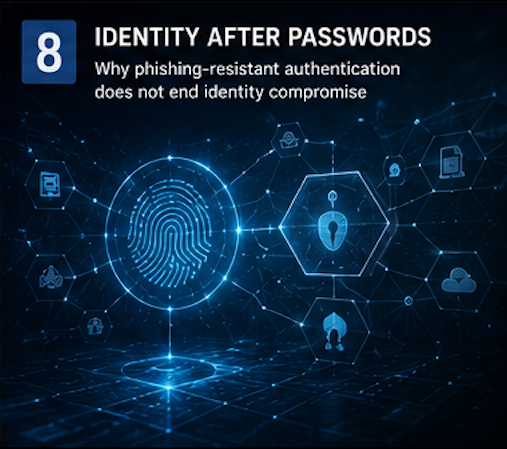
Many organizations still reduce identity security to authentication.
Passwords.
Multi-factor authentication.
Single Sign-On.
Necessary controls.
Insufficient strategy.
Authentication answers one question:
Who are you?
Modern cybersecurity must answer several more:
Should this identity exist?
Should it perform this action?
Should it access this information?
Should it continue operating?
Identity governance begins after authentication succeeds.
Not before.
Final Thought
Firewalls protected networks.
Zero Trust protected users.
Artificial intelligence requires us to protect identities.
All identities.
Human.
Machine.
Agent.
Service.
Certificate.
API.
Secret.
The organizations that understand this transition early will build security architectures capable of supporting autonomous business.
Those that continue managing identities as administrative objects will discover that attackers have already redefined the perimeter.
The next generation of cybersecurity will not be organized around devices.
It will be organized around trust.
Publication Note & Disclaimer
This article provides security and governance analysis, not legal advice. Regulatory obligations must be assessed against the facts, jurisdictions, data types, and roles of the organizations involved.
This article reflects my personal professional perspective and does not represent the official policy or position of my employer. Drafting and editorial refinement may have been supported by commercially available AI-assisted tools. The analysis, conclusions and final curation are entirely my own.
For information regarding image credits, copyrights, trademarks and other intellectual property rights, please refer to the Imprint.

Member discussion