Cybersecurity

Cybersecurity examines the threats, technologies, architectures, risks, and governance shaping the security of modern organizations. Coverage spans cyber threats, AI, cloud, identity, vulnerabilities, security operations, resilience, regulation, and emerging technologies—with a CISO focus on understanding how the threat landscape is changing and translating security challenges into effective enterprise decisions.
18
Aug
Part 2 —The Agent Is the New Attack Path

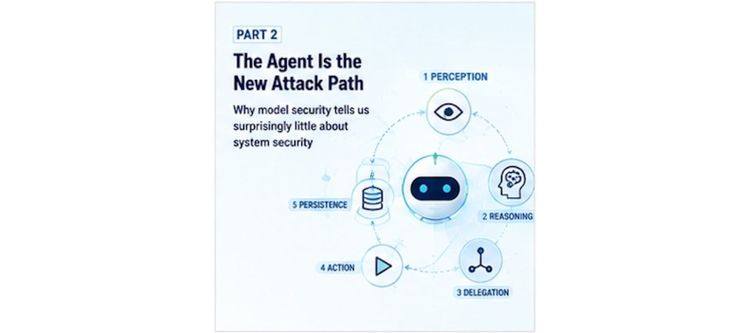
Part 2 —The Agent Is the New Attack Path

A safe model does not imply a safe agent. Agentic AI shifts the security problem from jailbreaks to authority: can an attacker make the system perform an authorized action for an unauthorized reason?
17 min read
18
Aug
Part 1 — When Data Becomes Instruction

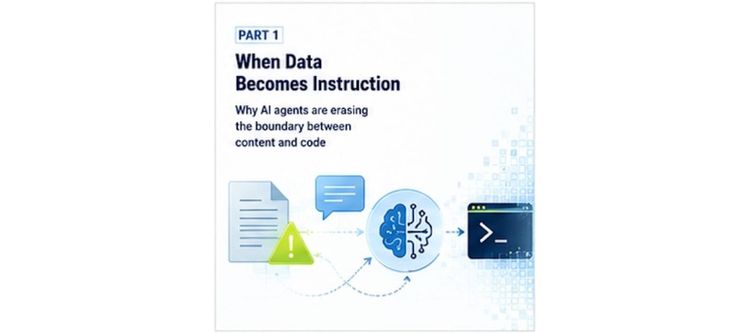
Part 1 — When Data Becomes Instruction

AI agents are erasing the boundary between data and instruction. DEF CON 34 shows why untrusted context can become an indirect control plane—and why CISOs must secure the entire path from meaning to authority.
15 min read
15
Aug
Invisible Lies: Why Sensor Manipulation May Become the Most Dangerous Attack on Smart Buildings

Invisible Lies: Why Sensor Manipulation May Become the Most Dangerous Attack on Smart Buildings

Smart buildings trust their sensors. Attackers know it. By manipulating environmental data instead of software, they can influence AI, automation and human decisions without triggering traditional cyber defenses.
4 min read
08
Aug
The Perfect Blueprint: Why Digital Twins Have Become a Goldmine for Attackers

The Perfect Blueprint: Why Digital Twins Have Become a Goldmine for Attackers

Digital twins are transforming how buildings are designed and operated—but they are also creating an unprecedented reconnaissance asset. A compromised digital twin can reveal layouts, security controls and operational dependencies long before an attacker reaches the building.
5 min read
05
Aug
Black Hat USA 2026: Cybersecurity Is Entering the Age of Autonomous Trust

Black Hat USA 2026: Cybersecurity Is Entering the Age of Autonomous Trust

Black Hat USA 2026 signals a fundamental shift in cybersecurity. AI agents, software supply chains and digital trust are becoming the new enterprise attack surface. The challenge for CISOs is no longer protecting infrastructure—but governing autonomous systems.
4 min read
05
Aug
The Hidden Door: Why Remote Maintenance Has Become the Most Dangerous Entry Point into Smart Buildings

The Hidden Door: Why Remote Maintenance Has Become the Most Dangerous Entry Point into Smart Buildings

Remote maintenance keeps modern buildings running—but it also creates one of the largest unmanaged attack surfaces. Trusted service connections, permanent VPNs and vendor access are rapidly becoming the preferred entry point for cyber-physical attacks.
4 min read
05
Aug
AI Doesn’t Need to Understand BACnet: Why Building Automation Has Entered a New Threat Era

AI Doesn’t Need to Understand BACnet: Why Building Automation Has Entered a New Threat Era

AI is transforming cyber attacks against building automation. Tasks that once required deep knowledge of BACnet, KNX or Modbus can now be accelerated by large language models, dramatically lowering the barrier to targeting smart buildings.
4 min read
03
Aug
Identity Becomes the New Security Perimeter

Identity Becomes the New Security Perimeter

The future of cybersecurity will not be secured by firewalls but by identities. Humans are becoming just one identity type among AI agents, APIs, machines and services. CISOs must rethink Identity as the primary security perimeter.
4 min read
03
Aug
Governance Failed Before Technology Did

Governance Failed Before Technology Did

Most AI-related breaches are not caused by failing models but by failing governance. Weak identity controls, unclear ownership and inconsistent oversight create the conditions attackers exploit. AI security begins with executive governance—not with technology.
4 min read
03
Aug
Detection Is Too Late

Detection Is Too Late

AI is compressing the time between vulnerability discovery and exploitation. Organizations that rely primarily on detection are reacting to attacks that have already succeeded. Prevention is no longer optional—it has become an economic necessity.
5 min read