Black Hat USA 2026: Cybersecurity Is Entering the Age of Autonomous Trust
Every year, Black Hat offers a glimpse into the future of cybersecurity.
By Eckhart Mehler for CISOsCISO — a perspective on cybersecurity leadership, governance and the decisions that determine whether organizations retain control.
Some years are remembered for spectacular vulnerabilities.
Others for new attack techniques.
Black Hat USA 2026 feels different.
This year is less about discovering another critical exploit and more about recognizing that the very foundation of enterprise security is changing.
The traditional enterprise perimeter has been disappearing for years.
Now, another boundary is dissolving:
the boundary between software that assists people and software that acts on their behalf.
That distinction may become one of the defining cybersecurity challenges of the coming decade.
From Protecting Systems to Governing Decisions
For nearly thirty years, enterprise cybersecurity has focused on protecting technology.
Networks.
Servers.
Endpoints.
Applications.
Cloud workloads.
Today, organizations increasingly deploy systems that not only process information but also retrieve knowledge, invoke APIs, execute workflows, generate software, approve requests and collaborate with other systems.
These systems are no longer passive applications.
They are becoming operational participants.
The consequence is profound.
Cybersecurity is gradually shifting from protecting infrastructure to governing autonomous decision-making.
AI Agents Are Becoming Enterprise Identities
One message echoed repeatedly across the emerging themes of Black Hat 2026:
AI agents should no longer be viewed merely as applications.
They increasingly resemble privileged enterprise identities.
Unlike traditional automation, modern agents may simultaneously:
- access Microsoft 365
- retrieve confidential documents
- invoke enterprise APIs
- interact with ERP platforms
- trigger workflows
- communicate with other AI systems
- execute administrative tasks
In many organizations, these capabilities already exceed those of individual employees.
Yet governance models often still treat them as software components rather than privileged actors.
This is rapidly becoming untenable.
Future identity governance will need to encompass humans, service accounts, workloads and autonomous AI agents alike.
Trust Has Become the New Attack Surface
Historically, attackers sought vulnerabilities.
Increasingly, they seek trust.
Trust between cloud tenants.
Trust between software components.
Trust in AI-generated context.
Trust in software repositories.
Trust in supply chains.
Trust in enterprise knowledge.
Modern attacks rarely begin by breaking cryptography.
They begin by abusing relationships that organizations already consider trustworthy.
This represents a subtle but fundamental evolution.
The enterprise attack surface is expanding from infrastructure to ecosystems.
AI Changes the Economics of Cybercrime
Artificial intelligence does not merely automate existing attacks.
It changes their economics.
Activities that previously demanded highly specialized expertise can increasingly be accelerated through AI-assisted analysis:
- reverse engineering
- protocol analysis
- exploit development
- vulnerability triage
- malware adaptation
- phishing preparation
- reconnaissance
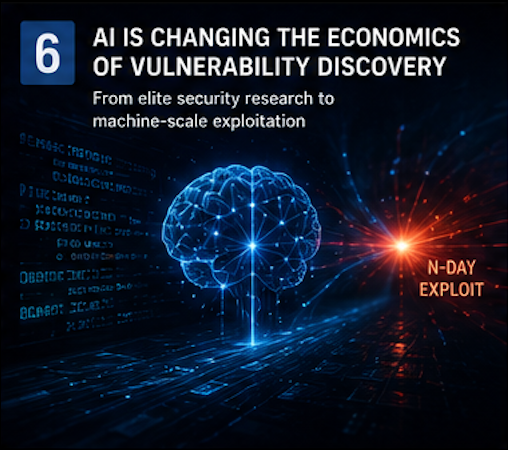
The most important consequence is not necessarily more sophisticated attacks.
It is dramatically shorter time between vulnerability discovery and exploitation.
For defenders, speed becomes a security control in its own right.
Software Supply Chains Continue to Expand
Several discussions surrounding Black Hat indicate another strategic transition.
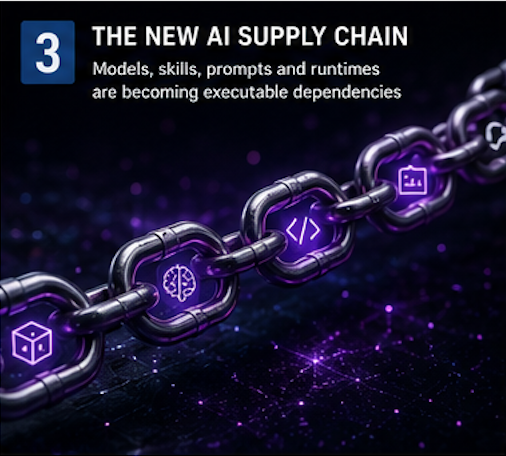
Software supply chains no longer consist solely of source code.
Increasingly they include:
- AI models
- prompts
- embeddings
- vector databases
- external knowledge sources
- AI plugins
- Model Context Protocol servers
- autonomous workflows
Every additional dependency introduces another trust relationship.
Every trust relationship becomes another potential attack path.
Supply-chain security is evolving into trust-chain security.
Hardware Security Is Returning
One of the more interesting developments this year is the renewed attention to hardware.
While software vulnerabilities remain abundant, researchers are increasingly demonstrating attacks against components supporting modern AI infrastructure.
As enterprises invest heavily in GPU-based computing, hardware assurance becomes part of enterprise cybersecurity rather than a niche concern.
Organizations planning large-scale AI deployments should therefore extend risk management beyond software and cloud services to include accelerator platforms and the underlying hardware ecosystem.
Governance Is Emerging as the Dominant Theme
Perhaps the most striking observation from Black Hat 2026 is what is not dominating the discussion.
Very few organizations now question whether AI should be used.
Instead, the central questions have become:
Who owns AI systems?
Who approves them?
Who monitors them?
Who audits them?
Who can retire them?
How are incidents reported?
How is accountability maintained?
The conversation has shifted from capability to governance.
That may ultimately prove to be Black Hat’s most important message.
The ISMS Must Evolve
Traditional Information Security Management Systems were designed around assets, risks and controls.
Those concepts remain valid.
But the definition of an asset is changing.
Modern ISMS implementations will increasingly need to manage:
- AI agents
- AI identities
- machine identities
- model inventories
- external AI services
- autonomous workflows
- digital trust relationships
Without visibility into these assets, meaningful risk management becomes impossible.
The organizations that adapt first will possess a significant strategic advantage.
What Every CISO Should Watch
Rather than focusing exclusively on individual exploits demonstrated in Las Vegas, CISOs should watch for broader structural changes.
Among the most important questions are:
- How are AI agents governed?
- How are AI identities authenticated?
- How are autonomous workflows monitored?
- How is enterprise knowledge protected from manipulation?
- How are AI components integrated into existing risk management?
- How are trust relationships continuously verified?
- How will software engineering evolve as AI accelerates vulnerability discovery?
These questions will likely remain relevant long after this year’s conference concludes.
Black Hat 2026 May Be Remembered for Something Different
Many Black Hat conferences become associated with specific vulnerabilities or memorable demonstrations.
Black Hat USA 2026 may instead be remembered as the conference that clarified a broader reality.
Enterprise cybersecurity is entering an era where the primary challenge is no longer protecting individual systems.
It is governing autonomous trust.
Organizations that continue to think only in terms of networks, endpoints and applications may find themselves securing yesterday’s infrastructure while tomorrow’s attack surface quietly expands around them.
The future of cybersecurity will not be defined solely by stronger technology.
It will be defined by stronger governance.
And governance begins long before the next breach.
CISO Takeaway
The latest sessions reinforce a strategic conclusion:
Black Hat USA 2026 is demonstrating that the next generation of enterprise security will be defined by secure engineering, AI governance, and trust management.
The organizations that gain an advantage will not simply deploy more AI—they will build governance for AI identities, secure AI infrastructure, and engineering practices that reduce systemic risk before vulnerabilities emerge.
Publication Note & Disclaimer
This article provides security and governance analysis, not legal advice. Regulatory obligations must be assessed against the facts, jurisdictions, data types, and roles of the organizations involved.
This article reflects my personal professional perspective and does not represent the official policy or position of my employer. Drafting and editorial refinement may have been supported by commercially available AI-assisted tools. The analysis, conclusions and final curation are entirely my own.
For information regarding image credits, copyrights, trademarks and other intellectual property rights, please refer to the Imprint.
Member discussion