Your CISO Has Eyes and Ears. Your AI Officer Probably Does Not.

Why AI Governance Without Security Telemetry Becomes Paper Governance
By Eckhart Mehler for CISOsCISO — a perspective on cybersecurity leadership, governance and the decisions that determine whether organizations retain control.
Most AI governance models begin with the visible part of the problem.
Policies.
Registers.
Approval workflows.
Risk assessments.
Steering committees.
Training materials.
Approved tools.
All of this matters.
But it does not tell you what is actually happening.
It tells you what the organization intended to happen.
That is not the same thing.
A policy can prohibit sensitive data from being entered into public AI tools.
A register can list approved models.
An approval process can define who may use an AI system.
A governance board can review high-risk cases.
And yet, somewhere in the organization, an employee may already be uploading confidential documents into an unapproved service.
A business unit may have connected a new AI assistant to SharePoint without telling anyone.
An agent may have received broader access than intended.
An API key may have been exposed.
A SaaS provider may have activated a new AI feature in the background.
A team may be building an internal RAG solution on a data source nobody has reviewed.
An employee may be trusting AI-generated results without understanding where they came from.
The governance model may look complete.
The operational reality may be completely different.
That is why AI governance without security telemetry becomes paper governance.
Governance sees what was declared
Security sees what is happening.
This distinction is becoming critical.
An AI Officer can maintain an AI inventory.
But an inventory is only as reliable as the information entering it.
If it depends entirely on self-declaration, it will always lag behind reality.
Employees do not always know that the software they use contains AI.
Departments may not classify an embedded copilot as a new system.
Procurement may buy a SaaS platform without understanding that it uses external models.
Developers may experiment with APIs under existing cloud subscriptions.
Business teams may activate features that appear to be productivity enhancements rather than AI deployments.
And users may bypass official tools because they are faster, better or simply easier to access.
This is not always malicious.
Often it is the opposite.
It is people trying to solve real problems.
But from a governance perspective, intent is not the decisive question.
Visibility is.
The AI Officer can coordinate governance only when the organization has a realistic picture of:
- where AI is being used;
- what data is being entered;
- which models are involved;
- what systems are connected;
- which identities are used;
- what permissions exist;
- what information leaves the organization;
- which costs are accumulating;
- which workflows are changing;
- which controls are actually functioning.
Without that picture, governance becomes an administrative exercise.
A well-maintained record of what people chose to disclose.
The CISO sees a different organization
The CISO does not see the organization through policies.
The CISO sees it through signals.
Identity logs.
Network events.
Cloud activity.
API calls.
Endpoint telemetry.
DLP alerts.
OAuth grants.
Privileged access events.
Suspicious downloads.
Data movements.
Security incidents.
Threat intelligence.
This is the difference between declared architecture and observed behavior.
The organization may say it uses only approved AI tools.
But the proxy logs may show traffic to dozens of unapproved services.
The organization may say no sensitive information leaves its environment.
But DLP alerts may show documents being uploaded to external domains.
The organization may say agents have limited permissions.
But IAM records may reveal service identities with broad access across collaboration platforms, data stores or business applications.
The organization may say an AI solution is only a pilot.
But token consumption, API traffic and user activity may show that it has quietly become operational.
This is why the CISO is not merely another stakeholder in AI governance.
The CISO provides the organization with operational truth.
Not always complete truth.
Not perfect truth.
But evidence that is closer to reality than the policy alone.
AI governance has a visibility problem before it has a compliance problem
Most organizations begin AI governance with the question:
Which rules do we need?
The better question is:
What do we need to see before we can decide whether the rules are working?
This changes the design of AI governance.
The first task is not simply creating a policy.
It is building observability.
Can the organization identify use of external AI services?
Can it see sensitive uploads?
Can it discover new connectors?
Can it identify AI-related OAuth applications?
Can it monitor service identities used by agents?
Can it detect unusual tool calls?
Can it trace which systems an agent accessed?
Can it identify abnormal token consumption?
Can it recognize when a vendor has introduced a new AI capability?
Can it detect when users are bypassing approved tools?
If the answer is no, then the organization is not governing AI.
It is governing declarations about AI.
Those are different things.
Shadow AI is not a user-behavior problem
It is a governance-design problem.
Organizations often speak about Shadow AI as if it were a discipline issue.
Employees should not use public models.
Teams should not activate unapproved tools.
Developers should not create unmanaged APIs.
Business units should not launch pilots without review.
But Shadow AI usually emerges because the organization has created a gap between demand and enablement.
People need help.
They need summaries, translations, research, drafting, analysis, automation and access to knowledge.
If the official environment does not provide safe, usable and fast options, people will find alternatives.
The security response cannot be limited to blocking.
The governance response cannot be limited to policy reminders.
The organization needs a model that combines control with enablement.
That means:
- approved tools that are actually useful;
- clear data-handling rules;
- low-friction pathways for low-risk use;
- fast review for legitimate business needs;
- monitored exceptions;
- transparent escalation;
- targeted detection for high-risk behavior;
- practical training that explains why controls exist.
The objective is not to eliminate all experimentation.
It is to ensure that experimentation does not become invisible production use.
The new AI attack surface is larger than the model
When organizations think about AI security, they often focus on the model.
Can the model hallucinate?
Can it be jailbroken?
Can it produce harmful content?
These questions matter.
But they are only part of the picture.
The bigger risk often sits around the model.
The connectors.
The APIs.
The identities.
The prompts.
The uploaded files.
The vector databases.
The training data.
The RAG sources.
The plug-ins.
The orchestration layer.
The cloud configuration.
The agent permissions.
The logs.
AI systems do not operate in isolation.
They sit inside an ecosystem of access rights, data pipelines, cloud services and business workflows.
That ecosystem creates the real attack surface.
A model does not need to be compromised to create harm.
It may simply be connected to too much.
An agent does not need to be malicious to become dangerous.
It may simply be overprivileged.
A RAG system does not need to leak data intentionally.
It may retrieve information from sources that were never meant to be combined.
A copilot does not need to be broken.
It may simply expose the consequences of weak permissions that already existed.
AI does not always create new weaknesses.
Sometimes it makes existing weaknesses usable at scale.
AI agents turn governance into a monitoring problem
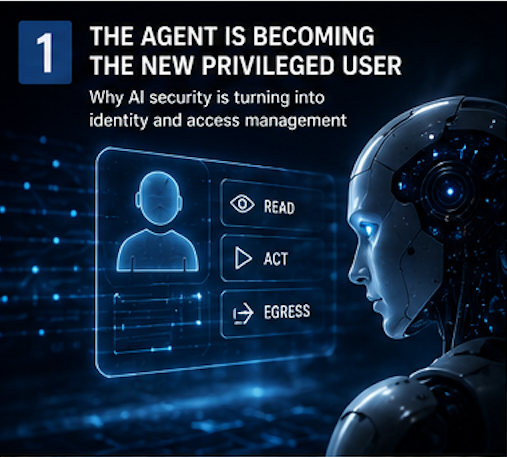
The moment an AI system can act, not merely answer, governance must become more operational.
A chatbot that summarizes a document has limited authority.
An agent that can access SharePoint, create tickets, query SAP, send messages or trigger workflows has delegated authority.
That is a fundamentally different risk category.
The key question becomes:
What can this agent do when nobody is watching?
This is where the SOC and CSOC become essential.
They can detect patterns that no policy document will reveal:
- an agent reading unusually large volumes of data;
- unexpected access to sensitive repositories;
- repeated failed authentication attempts;
- new OAuth permissions;
- abnormal API usage;
- execution outside expected hours;
- unusual geographic access;
- unexpected tool chains;
- mass changes triggered through automation;
- data movement that does not fit the stated business purpose.
This does not mean that every AI event should become a security incident.
It means that AI governance requires a monitored operational baseline.
Without it, the organization cannot distinguish normal use from dangerous drift.
Detection is not just a security capability
It is a governance capability.
This is a shift many organizations have not yet understood.
Traditionally, security detection was about identifying attacks.
Malware.
Compromised accounts.
Lateral movement.
Data exfiltration.
Privilege escalation.
Suspicious behavior.
In AI environments, detection must also support governance questions.
Which AI tools are being used?
Which are unapproved?
Which teams are creating new data flows?
Which agents have gained new permissions?
Which models are generating abnormal consumption?
Which connectors are appearing outside approved architecture?
Which policies are being bypassed?
Which approved systems are behaving differently after an update?
This does not turn the SOC into the AI governance office.
It gives AI governance the operational information it needs to remain connected to reality.
The SOC detects.
The AI Officer interprets governance significance.
The CISO assesses security implications.
The business owner explains operational purpose.
The organization decides whether controls need to change.
That is how telemetry becomes governance.
What the AI Officer should receive from security operations
The AI Officer does not need raw log data.
They do not need to analyze every alert.
They do not need to operate a SIEM.
But they need a structured AI risk picture from security operations.
For example:
- newly detected external AI services;
- repeated use of unapproved AI tools;
- sensitive-data uploads to AI destinations;
- new AI-related OAuth applications;
- new agent service accounts;
- agents with privileged or write access;
- API-key exposure;
- suspicious token consumption;
- AI-related data-exfiltration alerts;
- prompt injection attempts;
- unusual RAG access patterns;
- security incidents involving AI services;
- control failures requiring governance action.
This should not be a monthly spreadsheet full of technical details.
It should be an operational risk feed.
A concise view of where observed behavior no longer matches approved governance.
That difference is where action is needed.
The AI Officer must turn telemetry into decisions
Security telemetry alone does not solve the problem.
It creates signals.
Someone still has to decide what they mean.
A rise in use of an external AI service may indicate Shadow AI.
Or it may indicate that an official tool is not meeting user needs.
A new connector may represent a security risk.
Or it may represent a valid business use case that bypassed the process because the process was too slow.
A sharp increase in token consumption may indicate inefficient architecture.
Or a compromised API key.
Or an agent loop.
Or a successful adoption wave.
The AI Officer’s role is to turn observed patterns into governance decisions.
Should a tool be approved, blocked or reviewed?
Should a business unit receive a safer alternative?
Should an agent be paused?
Should a vendor be reassessed?
Should training be changed?
Should a new control be introduced?
Should an exception be escalated?
Should a policy be rewritten because it no longer matches operational reality?
This is why the AI Officer must work closely with the CISO.
Not as a subordinate security role.
Not as a separate compliance role.
But as the function that converts technical signals into enterprise control decisions.
AI governance needs a common language with the SOC
Many governance models fail because they use different language from security operations.
The AI Officer talks about risk classes, use cases, policies and compliance.
The SOC talks about alerts, indicators, detections, incidents and telemetry.
Both are right.
But if they do not connect, the organization creates two parallel realities.
One describes what should happen.
The other describes what is happening.
The solution is not to make the AI Officer a security analyst.
It is to create shared categories.
For example:
Governance question | Security signal |
|---|---|
Is unapproved AI being used? | AI-domain traffic, SaaS discovery, browser telemetry |
Is sensitive data leaving? | DLP events, proxy logs, CASB alerts |
Does an agent have too much authority? | IAM/PAM roles, API permissions, service-account access |
Is a system behaving unexpectedly? | abnormal API use, token spikes, unusual workflows |
Can we investigate an incident? | audit logs, model logs, connector logs, traceability |
Are controls still effective after change? | change events, access changes, detection trends |
This is the operational backbone of AI governance.
Not every control needs to be technical.
But every critical governance claim should be testable against reality.
The organization needs an AI control room, not another policy library
The future model is not an isolated AI policy repository.
It is an AI control room.
Not a physical room.
A management capability.
One that brings together:
- AI inventory;
- model and vendor information;
- business ownership;
- risk classification;
- data sensitivity;
- security telemetry;
- privacy requirements;
- cost signals;
- agent permissions;
- incidents;
- exceptions;
- review dates;
- control status.
The AI Officer should coordinate this picture.
The CISO should provide security visibility.
IT should provide platform and architecture insight.
Data governance should provide provenance and quality context.
Finance should provide consumption and cost transparency.
The business should provide purpose and outcome accountability.
This is what mature AI governance looks like.
Not a document that says what employees should do.
A system that shows whether the organization still knows what its AI is doing.
Governance without telemetry becomes trust without verification
The uncomfortable truth is that most organizations still rely heavily on trust.
They trust employees to follow policy.
They trust teams to disclose AI use.
They trust vendors to explain their features.
They trust managers to identify risk.
They trust projects to involve the right stakeholders.
Trust matters.
But trust is not a control.
Especially not in environments where AI can be activated quietly, connected quickly and scaled without obvious operational change.
The organization needs verification.
Not because employees cannot be trusted.
But because complex systems create blind spots.
And AI expands those blind spots faster than traditional governance processes can close them.
The CISO has the eyes and ears.
The AI Officer has the coordination mandate.
The two must work together.
Because the organization cannot govern what it cannot observe.
And it cannot observe AI effectively if it only looks at what people choose to report.
The real question is not whether you have an AI policy.
It is whether you can see when reality has moved beyond it.
Publication Note & Disclaimer
This article was originally published on LinkedIn on January 30, 2026 and may have been edited or updated for publication on this site.
It reflects my personal professional perspective and does not represent the official policy or position of my employer. Drafting and editorial refinement may have been supported by commercially available AI-assisted tools. The analysis, conclusions and final curation are entirely my own.
For information regarding image credits, copyrights, trademarks and other intellectual property rights, please refer to the Imprint.
Member discussion