The Rise of the AI Software Supply Chain
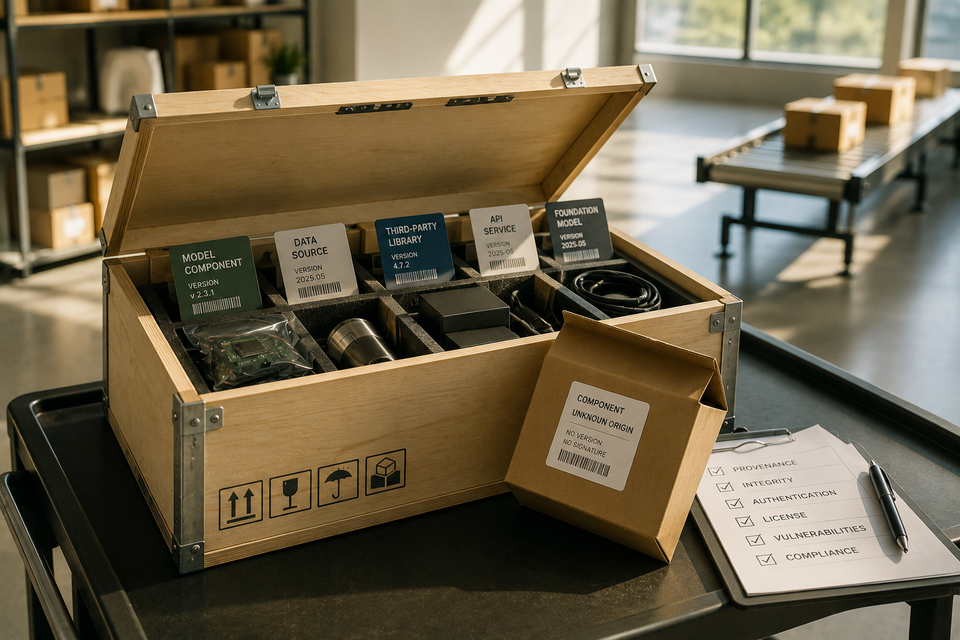
Organizations spent years securing software supply chains. Now they must secure the machines that generate them.
By Eckhart Mehler for CISOsCISO — a perspective on cybersecurity leadership, governance and the decisions that determine whether organizations retain control.
Over the last decade, cybersecurity leaders learned an uncomfortable lesson.
Most organizations no longer build software.
They assemble it.
Modern applications are not created from scratch.
They are constructed from:
- open-source libraries
- frameworks
- APIs
- cloud services
- containers
- third-party services
- software development kits
The result is a software supply chain of extraordinary complexity.
The security community responded.
Software Bills of Materials.
Supply chain security programs.
Dependency management.
Provenance controls.
Code signing.
Secure development frameworks.
The goal was clear:
Understand where software comes from.
Artificial Intelligence is now introducing a new challenge.
Not because software supply chains disappear.
But because they are becoming significantly harder to understand.
For the first time, organizations must govern not only the software they consume.
They must govern the machines that generate it.
The Original Supply Chain Problem
Historically, software supply chain risk was relatively straightforward.
A development team selected dependencies.
The dependencies were known.
They could be inventoried.
Audited.
Tracked.
Reviewed.
The risks were substantial.
But they were visible.
Security leaders could ask:
Which libraries are we using?
Which suppliers do we trust?
Which vulnerabilities affect us?
Which dependencies require remediation?
The answers were imperfect.
Yet they existed.
AI introduces a new level of abstraction.
The path from source to software becomes less transparent.
And transparency has always been the foundation of trust.
From Dependencies to Decisions
Traditional software supply chains focused on artifacts.
Libraries.
Packages.
Components.
AI introduces a different challenge.
Decisions.
Every AI-generated solution reflects decisions that originated somewhere.
Patterns.
Architectures.
Implementations.
Security assumptions.
Error handling.
Authentication approaches.
Data flows.
The generated output may appear entirely original.
Yet it is influenced by countless sources that contributed to the model’s understanding.
The organization receives the result.
The lineage becomes increasingly difficult to explain.
The Provenance Problem
One of the most important questions in modern cybersecurity is remarkably simple.
Where did this come from?
For years, organizations have invested heavily in answering that question.
Supply chain security exists because provenance matters.
If software cannot be trusted, neither can the systems that depend on it.
AI complicates provenance.
A generated solution may be influenced by:
- public code repositories
- open-source projects
- technical documentation
- coding patterns
- community practices
- training data
- model behavior
The resulting code may function perfectly.
Its origins remain difficult to reconstruct.
This creates a new governance challenge.
Organizations increasingly depend on outputs whose complete lineage may be impossible to explain.
The New Trust Relationship
Supply chain security has always been a trust problem.
Every dependency represents trust.
Every supplier represents trust.
Every cloud provider represents trust.
AI expands this trust model.
Organizations now place trust in:
- foundation models
- model providers
- training processes
- agent frameworks
- orchestration platforms
- autonomous tooling
Most enterprises understand supplier risk.
Far fewer understand model risk as a supply chain issue.
Yet the underlying principles are remarkably similar.
A dependency does not become trustworthy simply because it is useful.
Neither does an AI-generated output.
The Emergence of AI-Native Dependencies
Consider a future development environment.
Developers increasingly rely on AI systems to:
- generate code
- recommend libraries
- design architectures
- create infrastructure
- implement integrations
The generated outputs may introduce dependencies that no individual intentionally selected.
The recommendation becomes the decision.
The suggestion becomes the implementation.
The dependency enters production.
This creates a subtle but important shift.
Human selection gradually gives way to machine recommendation.
Accountability remains human.
Control becomes less obvious.
Why Traditional SBOMs May Not Be Enough
Software Bills of Materials have become a cornerstone of modern supply chain security.
They answer a critical question:
What components exist within this application?
AI introduces an additional question:
Why do these components exist?
Traditional SBOMs can identify dependencies.
They cannot explain the reasoning that introduced them.
As AI-generated software becomes more common, organizations may require something broader.
Not merely inventories of components.
Inventories of decisions.
A record of how software came to exist.
This challenge extends beyond compliance.
It reaches the heart of governance.
The Rise of Autonomous Supply Chains
The next phase of AI development may be even more transformative.
Agentic systems.
Autonomous development environments.
Self-improving workflows.
Machine-assisted decision-making.
These technologies promise extraordinary productivity gains.
They also create a new category of supply chain complexity.
The software supply chain no longer ends with code.
It increasingly includes systems capable of generating additional software.
The distinction is profound.
Organizations are no longer securing static dependencies.
They are securing dynamic systems capable of producing new dependencies.
Traditional governance models were not designed for this reality.
The Security Team’s Visibility Challenge
Most security programs already struggle with visibility.
Applications.
Cloud services.
APIs.
Identities.
Data flows.
Supply chain dependencies.
All require inventory and oversight.
AI introduces another layer.
Organizations must increasingly understand:
- which models are used
- which agents are deployed
- which tools generate code
- which systems influence development decisions
- which outputs enter production
Without visibility, governance becomes speculative.
Security leaders cannot assess risks they cannot identify.
The first challenge remains the same as it has always been.
Know what exists.
The difficulty is that AI is making that objective considerably harder.
The Regulatory Wave Is Coming
Regulators are beginning to recognize these challenges.
Around the world, governments are focusing on:
- software supply chain security
- AI governance
- digital resilience
- accountability
- critical infrastructure protection
The trend is clear.
Transparency expectations are increasing.
Organizations will increasingly be asked:
Can you explain how this software was created?
Can you explain which systems influenced its development?
Can you explain who remains accountable?
These are not technical questions.
They are governance questions.
And governance questions rarely disappear.
They tend to become regulatory requirements.
Why This Is Not Just an AI Problem
The temptation is to view AI supply chain risk as a specialized issue.
It is not.
At its core, this is a familiar challenge.
Trust.
Visibility.
Accountability.
Provenance.
These principles have always defined cybersecurity.
AI simply magnifies them.
The technology changes.
The governance challenge remains remarkably consistent.
Organizations must understand where critical capabilities originate.
They must understand who influences them.
And they must understand who remains accountable when things go wrong.
The Future Software Supply Chain
For years, the software industry focused on securing software components.
The next challenge may be securing software generation itself.
This requires a broader perspective.
Not merely:
What code entered production?
But also:
How was it created?
Which systems influenced it?
Which dependencies were introduced?
Which assumptions were inherited?
Which risks accompanied them?
These questions may become central to cybersecurity strategy during the next decade.
Because the software supply chain is no longer simply a chain of software.
It is increasingly a chain of decisions.
Some made by humans.
Some influenced by machines.
All carrying risk.
The Next Frontier of Trust
The cybersecurity profession has spent years improving visibility into software supply chains.
That effort remains essential.
But AI is expanding the problem space.
Organizations are moving from a world where dependencies were selected to a world where dependencies may be suggested, generated, or inherited through increasingly complex machine-assisted processes.
Trust becomes harder to establish.
Provenance becomes harder to explain.
Governance becomes more important than ever.
The challenge is not whether AI-generated software can be useful.
It clearly can.
The challenge is whether organizations can maintain sufficient visibility into the origins of what they deploy.
Because every generated line of code inherits assumptions, decisions, and risks from sources nobody can fully trace.
And cybersecurity has always been strongest when trust can be verified rather than assumed.
Publication Note & Disclaimer
This article was originally published on LinkedIn on January 30, 2026 and may have been edited or updated for publication on this site.
It reflects my personal professional perspective and does not represent the official policy or position of my employer. Drafting and editorial refinement may have been supported by commercially available AI-assisted tools. The analysis, conclusions and final curation are entirely my own.
For information regarding image credits, copyrights, trademarks and other intellectual property rights, please refer to the Imprint.

Member discussion