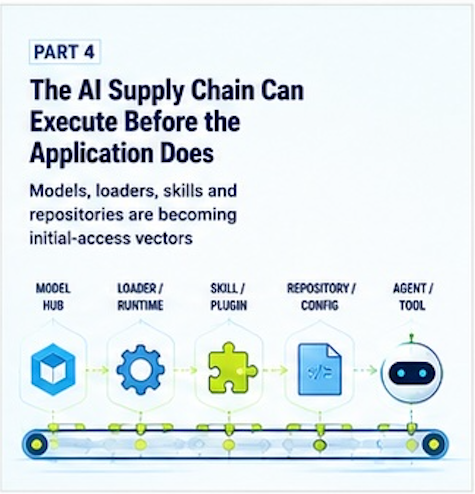
The AI Supply Chain Can Execute Before the Application Does
AI artifacts are no longer passive data. DEF CON 34 shows how models, Skills, repositories and loaders can become execution paths — forcing CISOs to rethink supply-chain security, provenance and runtime authority.
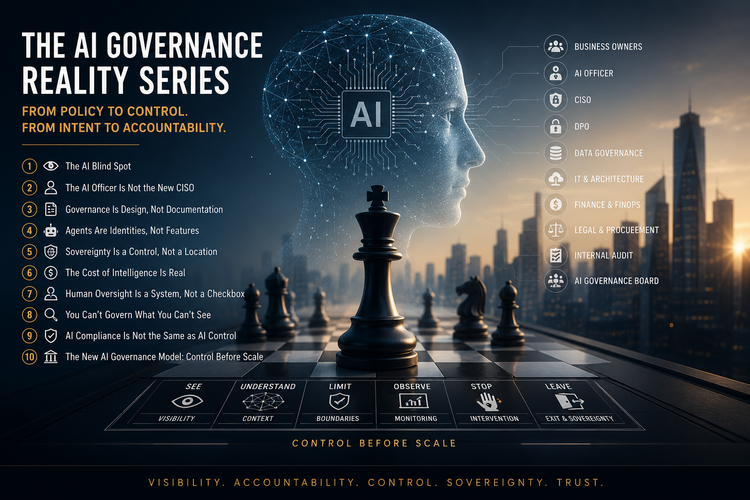
The AI Officer Is Not the New CISO
Appointing one person “responsible for AI” does not create control. It creates a super-role with responsibility for everything and authority over little. AI governance needs coordination — while security, privacy, business ownership and assurance remain distinct.
The Cheapest Model Is Rarely the Cheapest Decision
The cheapest model can create the most expensive outcome. AI FinOps must measure more than tokens: quality, risk, human review and business value. The real question is not what a model costs, but what each reliable decision costs.
Human in the Loop Is Becoming a Dangerous Fiction
A human click is not human control. Oversight fails when people lack the time, authority, evidence or confidence to challenge AI output. Real accountability requires humans who can understand, intervene, stop and reverse decisions when it matters.
The AI Control Gap
AI governance is becoming too small for the risks it is meant to manage. The real challenge is no longer responsible AI use, but whether organizations can still see, control, explain and stop the systems shaping their data, decisions, costs and dependencies.
The EU-US Data Transfer Framework Did Not Collapse. But Your Risk Model May Have.
The EU-US Data Privacy Framework is still in force. But the Supreme Court’s FTC ruling exposes a deeper problem: legal transfer mechanisms are not a substitute for sovereignty, resilience, or control. What CISOs should do now.
AI Compliance Is Not the Same as AI Control
Policies, registers and committees are necessary. But they do not prove control. AI governance becomes real only when organizations can observe what changes, detect what goes wrong, intervene quickly and explain what happened after the fact.