DEF CON 34 — What CISOs Should Take Away From the Hacker’s View of the Future
DEF CON 34 — Part 0 of 13
13 lessons from Las Vegas on agents, MCP, identity, cloud automation, AI infrastructure, hardware, physical systems and the changing economics of attack
By Eckhart Mehler for CISOsCISO — a perspective on cybersecurity leadership, governance and the decisions that determine whether organizations retain control.
The DEF CON 34 Series
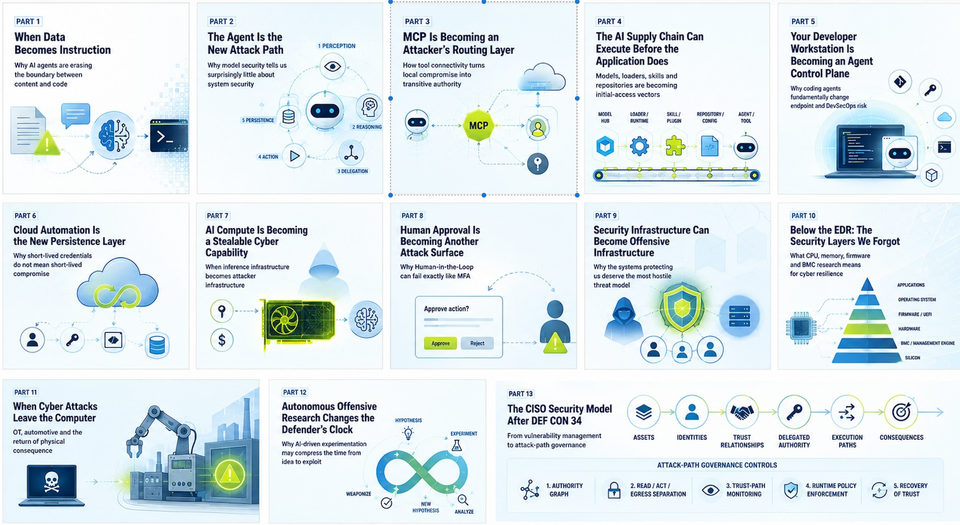
- Part 1 — From Vulnerability Management to Attack-Path Governance
- Part 2 — The Agent Is the New Attack Path
- Part 3 — MCP Is Becoming an Attacker’s Routing Layer
- Part 4 — The AI Supply Chain Can Execute Before the Application Does
- Part 5 — Your Developer Workstation Is Becoming an Agent Control Plane
- Part 6 — Cloud Automation Is the New Persistence Layer
- Part 7 — AI Compute Is Becoming a Stealable Cyber Capability
- Part 8 — Human Approval Is Becoming Another Attack Surface
- Part 9 — Security Infrastructure Can Become Offensive Infrastructure
- Part 10 — Below the EDR: The Security Layers We Forgot
- Part 11 — When Cyber Attacks Leave the Computer
- Part 12 — Autonomous Offensive Research Changes the Defender’s Clock
- Part 13 — The CISO Security Model After DEF CON 34
Every August, two very different versions of cybersecurity meet in Las Vegas.
Black Hat and DEF CON are closely connected historically, geographically and intellectually. In 2026, Black Hat USA ran from August 1–6, with DEF CON immediately following it. (Black Hat)
But attending both is not simply attending two cybersecurity conferences.
They provide two different lenses through which to look at the future of security.
And for a CISO, that distinction matters.
Black Hat Shows You the Security Industry. DEF CON Shows You What Happens When People Refuse to Accept Its Assumptions.
That distinction is deliberately simplified.
Black Hat is deeply technical. Its Briefings remain one of the places where serious security research enters the professional security mainstream. In 2026, the program included more than 100 peer-reviewed Briefings, more than 100 Trainings and more than 80 Arsenal demonstrations. AI and autonomous threats were among the explicit themes. (Black Hat)
But Black Hat has also become a major professional security ecosystem. CISOs meet other CISOs. Vendors demonstrate platforms. Analysts discuss markets. Security leaders discuss governance, resilience and operating models. Researchers present mature findings.
In 2026 this became even more visible through dedicated formats including the CISO Summit, AI Summit and AI Zone. (Black Hat)
DEF CON feels different. The intellectual instinct is different.Instead of asking: How should we secure this technology?
the hacker instinct often begins with: What happens if the assumptions behind this technology are wrong?
- What if I connect these two things that were never supposed to interact?
- What if the security mechanism itself becomes the attack surface?
- What if the trusted input is hostile?
- What if the identity is legitimate but the actor using it is not?
- What if the credential expires but the mechanism creating the credential remains compromised?
- What if the operating system is clean but the machine is not?
- What if the attack does not stop at the computer?
And increasingly: What if the attacker is no longer the only thing making decisions?
That is why DEF CON matters to CISOs. It gives us an early view of problems that do not yet fit comfortably into our control frameworks.
What Made DEF CON 34 Different
My central takeaway from DEF CON 34 is not one vulnerability, exploit or technology.
It is a structural change in the attack surface.
For decades, cybersecurity has organized itself around objects.
- Endpoints.
- Servers.
- Applications.
- Networks.
- Accounts.
- Databases.
- Cloud workloads.
- APIs.
- We inventory them.
- We classify them.
- We scan them.
- We patch them.
- We assign controls to them.
- We calculate residual risk.
But attackers increasingly do not need to defeat an individual object.
They exploit the relationships between objects.
An AI agent reads a document.
The document influences the agent.
The agent invokes an MCP tool.
The tool operates through an identity.
The identity obtains temporary credentials.
Those credentials access a cloud service.
The cloud service modifies an automation pipeline.
The pipeline creates another credential.
That credential reaches another environment.
There may be no single catastrophic vulnerability anywhere in that chain.
The vulnerability emerges from the composition.
That is the thread connecting the research themes that interested me most at DEF CON 34.
AI agents.
MCP.
Managed identities.
Developer workstations.
CI/CD pipelines.
Inference infrastructure.
Human approval.
Security tools.
Firmware.
Industrial systems.
Autonomous vulnerability research.
They initially appear to be separate security domains.
I increasingly believe they are manifestations of the same problem:
Cybersecurity is moving from protecting components toward governing authority paths.
Who can instruct whom?
Who can authenticate as whom?
Who can invoke what?
Which system trusts which output?
Which automation can create another identity?
Which agent can cross another security boundary?
And ultimately:
Who—or what—can cause what to happen?
That question became the organizing principle for this 13-part DEF CON 34 series.
From Assets to Authority
That is my most important takeaway from DEF CON 34.
The security industry has spent decades becoming better at protecting things.
We inventory things.
Scan things.
Patch things.
Monitor things.
Authenticate things.
Segment things.
Encrypt things.
But modern digital systems are increasingly defined not by their individual components but by their relationships.
And AI accelerates that development.
Agents connect identities to tools.
MCP connects agents to services.
APIs connect services to business processes.
Automation connects identities to infrastructure.
CI/CD connects developers to production.
Security platforms connect telemetry to privileged response.
Cloud platforms connect workloads to dynamically issued authority.
The attack surface therefore increasingly exists between the boxes on the architecture diagram.
That is precisely where conventional control frameworks often provide the least visibility.
The Question I Brought Home From Las Vegas
After Black Hat, I found myself thinking about technologies, architectures and security programs.
After DEF CON, the question became more fundamental.
When I look at an architecture now, I increasingly want to know:
What can cause what?
Not merely:
Who has access?
Not merely:
Which vulnerabilities exist?
Not merely:
Which systems are internet-facing?
But:
Which instruction can reach which agent?
Which agent can invoke which tool?
Which tool can assume which identity?
Which identity can trigger which automation?
Which automation can create which credential?
Which credential can reach which environment?
And which of those actions can ultimately produce an irreversible business or physical consequence?
That is not simply attack-surface management.
It is not simply identity security.
It is not simply Zero Trust.
And it is certainly not simply AI security.
It is the governance of delegated authority across interconnected systems.
DEF CON 34 convinced me that this may become one of the defining cybersecurity challenges of the next decade.
Because the attacker of the future may not need to break every component.
They may only need to discover the path between them.
Next in the series: Part 1 — When Data Becomes Instruction — why AI agents are erasing the boundary between data and instruction, and how untrusted context can become an indirect control plane—forcing CISOs to secure the entire path from what a system reads, to what it interprets, to what it is ultimately authorized to do.
Publication Note & Disclaimer
This article provides security and governance analysis, not legal advice. Regulatory obligations must be assessed against the facts, jurisdictions, data types, and roles of the organizations involved.
This article reflects my personal professional perspective and does not represent the official policy or position of my employer. Drafting and editorial refinement may have been supported by commercially available AI-assisted tools. The analysis, conclusions and final curation are entirely my own.
For information regarding image credits, copyrights, trademarks and other intellectual property rights, please refer to the Imprint.




Member discussion