AI Reliability Is Not Uptime

Why a Green Dashboard Can Hide a Failed AI Service
By Eckhart Mehler for CISOsCISO — a perspective on cybersecurity leadership, governance and the decisions that determine whether organizations retain control.
For decades, availability has been one of the most familiar concepts in information technology.
A system is available when users can reach it, requests are processed and the service responds within an agreed time. Organisations translate this expectation into service-level agreements, uptime targets, recovery objectives and operational dashboards.
The model is well established.
A service is either running or unavailable.
An endpoint responds or it does not.
A transaction succeeds or fails.
A component remains within its defined operating parameters or triggers an alert.
AI systems do not fit comfortably into this model.
An AI service may be technically reachable, respond with low latency and produce polished output while already failing at the purpose for which it was deployed.
The endpoint is available.
The capability is not.
This distinction is becoming one of the most important operational and governance challenges in enterprise AI.
The problem is not that uptime has become irrelevant. Technical availability remains essential. An AI system that cannot be reached cannot support a business process.
The problem is that uptime describes only one layer of reliability.
It does not tell the organisation whether:
- the answer is still correct,
- the relevant evidence was available,
- the knowledge source was current,
- the model interpreted the task properly,
- the agent completed the requested action,
- the system operated within its mandate,
- or the result remains safe enough to use.
A green infrastructure dashboard may therefore coexist with a failed AI service.
The Comfort of a Familiar Metric
Uptime is attractive because it is measurable.
It can be expressed as a percentage. It can be monitored continuously. It can be assigned to a provider. It can be included in a contract and reported to management.
An availability target of 99.9 per cent appears precise.
It tells the organisation how often the service endpoint was expected to be reachable during a defined period.
It does not tell the organisation whether the service produced usable outcomes.
This limitation is not unique to AI. A conventional application can also be technically available while providing a poor user experience or processing incorrect data.
AI makes the problem more severe because the system may continue producing plausible output when important reliability conditions have already failed.
A database typically rejects a malformed query.
A business application may display an error when a required field is missing.
An API may return a failure status when a transaction cannot be completed.
A language model often attempts to continue.
If context is incomplete, it may infer.
If evidence is weak, it may still formulate an answer.
If a tool response is ambiguous, it may describe the most plausible outcome.
If a relevant source is missing, it may rely on general model knowledge.
The service therefore remains responsive precisely when a conventional system might have failed visibly.
That responsiveness can be mistaken for availability.
The Difference Between Response and Service
An AI endpoint returning a response does not prove that the intended service was delivered.
This becomes clear when the service is defined from the perspective of the business process rather than the technical component.
Consider an internal policy assistant.
Its purpose is not merely to generate text. Its purpose is to provide employees with reliable guidance based on approved corporate rules.
The assistant receives a question and returns a professionally written answer in three seconds.
Technically, the service is available.
But the underlying retrieval system has not indexed the latest version of the relevant policy. The answer is based on an obsolete document.
The language-generation service was available.
The policy-guidance service was not.
Now consider a security assistant used to prioritise alerts.
The system remains online and continues generating recommendations. A change in telemetry ingestion means that one important source is no longer available to the model.
The AI still produces a ranked list.
The dashboard shows normal response times.
But the recommendations are based on incomplete evidence.
The AI service remains technically available while its ability to support security decisions has degraded.
The same distinction becomes even more important with agents.
An agent is instructed to update a supplier record. It formulates the correct request and calls the relevant tool. The target system times out before confirming the change.
The agent reports that the update has been completed.
The conversational layer is available.
The orchestration layer is available.
The business action is not complete.
The service has responded without delivering the required state change.
Availability Must Be Defined at the Point of Value
For an AI system, availability should not be defined solely at the model endpoint.
It should be defined at the point where the organisation expects value to be created.
That point may be:
- a supported decision,
- a reliable recommendation,
- a verified answer,
- a completed transaction,
- a correctly prioritised security event,
- a valid classification,
- or a safely executed process step.
This changes the measurement problem.
A service is not available merely because its components are running.
It is available when it can perform its authorised function within the required quality, time, security and evidence boundaries.
For conventional infrastructure, this broader view is often described through service availability rather than component availability.
For AI, the distinction must go further.
An AI capability can be technically available and semantically unavailable.
It can be operationally available and legally unusable.
It can be responsive and still unsafe.
The Layers of AI Availability
AI availability should be understood as a multidimensional property.
No single metric captures all relevant dimensions.
Technical availability
Technical availability describes whether the AI application, model endpoint and supporting infrastructure can be reached.
Typical indicators include:
- endpoint uptime,
- API error rates,
- request success rates,
- latency,
- throughput,
- resource utilisation,
- queue length,
- provider status,
- and network availability.
These metrics are mature and necessary.
They provide visibility into the operational health of the technical platform.
They do not establish the reliability of the result.
Capacity availability
A system may be reachable but unable to provide adequate service under load.
Capacity availability includes:
- rate limits,
- token quotas,
- concurrency restrictions,
- context-window limits,
- throttling,
- GPU shortages,
- regional capacity,
- and provider-side load management.
An AI service may technically remain online while delivering degraded response times, truncated context or lower-quality fallback models.
The business may experience a service failure even though the provider does not classify the condition as an outage.
Functional availability
Functional availability describes whether the system can perform the task for which it was deployed.
A document assistant that cannot access documents is not functionally available.
An agent that can plan but cannot call its required tools is not functionally available.
A security copilot without current telemetry may remain technically operational but cannot fulfil its intended function.
Functional availability therefore depends on the complete chain of components, not only the model.
Contextual availability
An AI system requires sufficient and appropriate context.
Contextual availability asks whether the information needed for a reliable output is actually present.
Possible failures include:
- missing documents,
- inaccessible data,
- outdated indexes,
- incorrect permissions,
- incomplete conversation history,
- truncated context,
- failed connectors,
- or incompatible data formats.
A model can respond without the required context.
The ability to answer must not be confused with the availability of the information needed to answer correctly.
Semantic availability
Semantic availability describes whether the output remains sufficiently correct, relevant and supported for its intended use.
This is the dimension that conventional monitoring is least equipped to observe.
A response may be grammatically correct and logically coherent while being:
- factually wrong,
- incomplete,
- irrelevant,
- misleading,
- unsupported,
- or based on an incorrect interpretation of the request.
Semantic availability cannot usually be measured through infrastructure telemetry alone.
It requires evaluation of output quality, evidence and business meaning.
Temporal availability
An AI system may provide the right answer too late.
This matters in environments such as:
- incident response,
- fraud detection,
- operational decision-making,
- customer service,
- financial processing,
- and real-time control.
A response generated after the decision point has passed is no longer operationally useful.
Temporal availability must therefore be linked to the process, not merely to average model latency.
Safe availability
An AI system may be capable of performing an action but unable to do so within acceptable security or compliance boundaries.
For example:
- the required data may not be permitted for the selected model,
- the provider region may no longer be approved,
- the system may lack sufficient evidence for a high-impact decision,
- the agent may have lost access to a mandatory approval service,
- or the fallback model may not meet the required security standard.
In these cases, the system may be technically available but safely unavailable.
The correct response may be to refuse, restrict or stop operation.
Organisational availability
A system can remain technically functional while the organisation loses the capability to operate it responsibly.
This may occur when:
- key expertise is no longer available,
- the provider withdraws support,
- contractual rights are insufficient,
- documentation is incomplete,
- the model can no longer be reproduced,
- manual fallback procedures have disappeared,
- or responsibility for the system is unclear.
Organisational availability asks whether the organisation still possesses the people, processes, authority and evidence required to control the service.
This dimension becomes increasingly important as AI capabilities become embedded in critical operations.
The Green Dashboard Problem
Most enterprise dashboards remain infrastructure-centred.
They report:
- service availability,
- request volume,
- processing time,
- errors,
- resource consumption,
- and provider status.
These metrics are useful.
But they create a specific risk when presented as evidence of AI reliability.
A dashboard may remain green while:
- the retrieval index is stale,
- the model has changed behaviour,
- relevant telemetry is missing,
- users are correcting a growing number of outputs,
- tool calls are failing silently,
- the system is relying on weaker fallback models,
- or the business outcome is deteriorating.
The problem is not that the dashboard is wrong.
It is measuring the wrong level of the system.
A technically accurate dashboard can still produce an operationally misleading picture.
Management may see a stable service while users experience declining reliability.
This creates a reporting gap.
The organisation measures whether the system is responding.
It does not measure whether the system is still fit for purpose.
AI Can Fail Gracefully in the Wrong Direction
Graceful degradation is a recognised principle in resilient system design.
When part of a system becomes unavailable, the service should continue in a reduced but predictable mode.
AI systems may appear to degrade gracefully while actually becoming less trustworthy.
A model with missing context may continue using general knowledge.
A primary model under load may be replaced by a smaller fallback model.
A failed retrieval component may be bypassed.
An unavailable tool may lead the model to describe what the user should do manually.
These behaviours may preserve responsiveness.
But the resulting service is not necessarily equivalent to the approved service.
The fallback may:
- use different knowledge,
- follow instructions differently,
- have weaker safety behaviour,
- produce lower-quality results,
- or lack the evidence required for the intended decision.
A fallback therefore cannot be evaluated only by whether it returns an answer.
It must be evaluated against the same purpose and risk requirements as the primary system.
Graceful degradation must mean controlled reduction of capability.
It must not mean invisible reduction of reliability.
The Difference Between Failure and Refusal
In conventional service management, a refusal to process a request may be treated as a service failure.
For AI, refusal can be a sign of correct operation.
A reliable system should recognise conditions under which it cannot provide a sufficiently supported answer or safely perform an action.
It may need to state:
- insufficient evidence,
- source unavailable,
- authorisation missing,
- tool result not confirmed,
- confidence below threshold,
- conflicting information,
- or human review required.
This may reduce apparent task-completion rates.
It can increase actual reliability.
A system that refuses when required may be more available as a trustworthy service than one that always produces an answer.
This creates a governance challenge.
If the organisation rewards only speed, response volume and automation rates, the system will appear more successful when it takes greater risks.
Reliability metrics must therefore distinguish between:
- unnecessary refusal,
- justified refusal,
- unsupported completion,
- and safe escalation.
The aim is not to maximise the number of answers.
The aim is to maximise dependable outcomes within the authorised risk boundary.
Why Average Accuracy Is Not an Availability Metric
AI systems are frequently evaluated through accuracy or similar aggregate performance measures.
These metrics are important, but they do not describe service availability on their own.
An accuracy score of 95 per cent may conceal very different risk profiles.
The five per cent of errors may be:
- randomly distributed,
- concentrated in a particular language,
- associated with one country,
- triggered by rare inputs,
- related to vulnerable users,
- or concentrated in the most critical decisions.
A system can perform well on average and still be unavailable for a specific business context.
The relevant question is not only how often the system is correct.
It is where, when and under which conditions it fails.
This requires segmented measurement.
Reliability should be evaluated by:
- use case,
- user group,
- language,
- geography,
- data source,
- transaction type,
- risk level,
- model version,
- and operational condition.
An average can hide the exact failures that matter most.
From SLA to AI Reliability Objectives
Traditional service-level agreements remain necessary for infrastructure and provider management.
But they should be complemented by AI-specific reliability objectives.
These objectives must be tied to the intended use.
Possible measures include:
Grounded-answer rate
The proportion of answers that are supported by relevant and current evidence.
Citation correctness
The proportion of citations that actually support the claims made.
Context availability
The proportion of requests for which all required data sources were accessible and current.
Task-completion rate
The proportion of tasks that were completed successfully in the relevant target system.
Confirmed-action rate
The proportion of agent actions independently confirmed by the target application.
Critical-error rate
The number of errors capable of causing significant financial, legal, security or operational harm.
Human-correction rate
The proportion of outputs that require meaningful correction before use.
Safe-refusal rate
The proportion of cases in which the system correctly refuses or escalates because reliability conditions are not met.
Fallback success rate
The proportion of degraded operations that remain within approved quality and security thresholds.
Recovery time to trusted state
The time required not merely to restore technical service, but to re-establish a verified and approved operating condition.
These metrics are not universally applicable.
They must be selected according to the purpose and risk of the system.
The central principle is that reliability objectives should measure the service the organisation actually depends on.
The Business Outcome Must Be Observed
AI monitoring should not stop at the system boundary.
Where possible, the organisation must observe the business outcome.
For an agent, success should be confirmed by the target system.
For a document assistant, quality may be reflected in correction rates, complaints and escalations.
For a security tool, reliability may be assessed through missed incidents, false prioritisation and analyst overrides.
For a classification system, performance must be compared with known outcomes over time.
This creates a closed feedback loop.
Without business-outcome monitoring, the organisation sees only what the AI system says it has done.
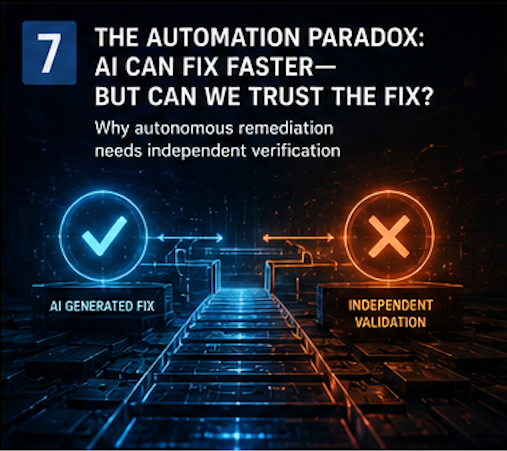
A self-reported success is not sufficient evidence.
The further AI moves from text generation towards operational action, the more important independent outcome verification becomes.
The CISO’s Governance Response
The CISO should not replace operational service management.
But the CISO should challenge any claim that infrastructure availability proves AI reliability.
At minimum, governance should require:
- a clearly defined business service,
- identified critical failure modes,
- reliability objectives beyond uptime,
- monitoring of relevant data and context,
- controls for model and prompt changes,
- evidence of successful tool execution,
- business-outcome validation,
- thresholds for safe refusal,
- approved degradation modes,
- and a defined authority to restrict or stop the system.
The CISO should also insist that management reporting separates:
- technical uptime,
- functional availability,
- semantic quality,
- security compliance,
- and business success.
Combining these dimensions into a single green status obscures risk.
A system may be green in one dimension and red in another.
That is not a reporting inconvenience.
It is the reality of AI-enabled operations.
The New Meaning of Availability
AI does not make traditional availability obsolete.
It reveals how incomplete the traditional definition becomes when software is expected not only to process instructions, but also to interpret, recommend and act.
For AI systems, availability must mean more than the presence of a response.
It must mean that the system can perform its authorised function:
- with sufficient evidence,
- within the required time,
- at the necessary quality,
- inside defined security boundaries,
- and with a verifiable business outcome.
Anything less risks confusing communication with service.
The defining question is no longer:
Did the model respond?
It is:
Was the intended capability available in a form the organisation could safely rely upon?
This distinction will shape how AI services are designed, monitored and governed.
Because a system that answers without the information, authority or ability required to fulfil its purpose is not truly available.
It is merely online.
Publication Note & Disclaimer
This article reflects my personal professional perspective and does not represent the official policy or position of my employer. Drafting and editorial refinement may have been supported by commercially available AI-assisted tools. The analysis, conclusions and final curation are entirely my own.
For information regarding image credits, copyrights, trademarks and other intellectual property rights, please refer to the Imprint.



Member discussion